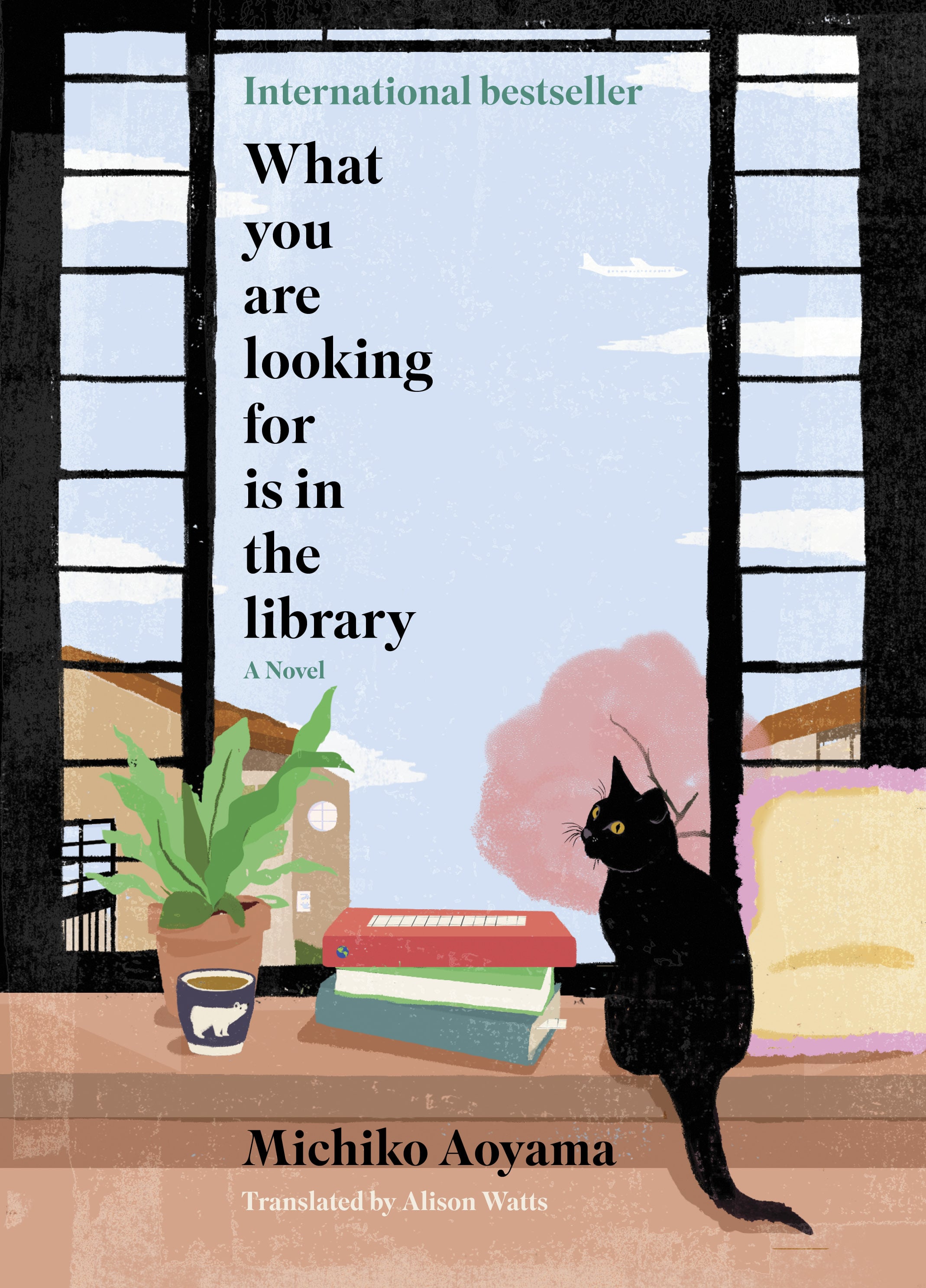
Author: Michiko Aoyama
Date Read: 6th January 2026
⭐ Rating
🌕🌕🌕🌕🌑
📖 Synopsis / Plot
Source: What you are looking for is in the library
What are you looking for?
This is the famous question routinely asked by Tokyo’s most enigmatic librarian, Sayuri Komachi. Like most librarians, Komachi has read every book lining her shelves - but she also has the unique ability to read the souls of her library guests
For anyone who walks through her door, Komachi can sense exactly what they’re looking for in life and provide just the book recommendation they never knew they needed to help them find it.
Each visitor comes to her library from a different juncture in their careers and dreams, from the restless sales attendant who feels stuck at ther job to the struggling working mother who longs to be a magazine editor. The conversation that they have with Sayuri Komachi - and the surprise book she lends each of them - will have life-altering consequences.
✍️ Review
I absolutely enjoyed the book. It’s exactly what I’m looking for; the kind of book that explores real-world lessons and problems in a charming yet relatable way. It’s easy to read and understand, yet it packs a punch that most people can relate to.
The book has only 5 chapters; each talking about a patron in different stages of their lives. Each chapter, so distinct to one another, can be a standalone short story, albeit there are recurring characters. I think to review this book, I can only do it justice by reviewing it chapter by chapter.
Chapter 1 - Taking Your Own Pace
This chapter follows Tomoka, a 21-year-old woman, working as a sales assistant, albeit not very good at it. This chapter strikes to me as a young person struggling to find meaning in her life. While being young, she watched her friends or her peers doing things that society finds meaningful or successful, in contrast to a sales assistant role. To Tomoka or to anyone of the same age, this perception made her feel small and as if she’s wasting her time away.
Society is moving faster than ever; so much so that a lot of people are struggling to keep up. The quote by Leon C. Megginson,
According to Darwin’s Origin of Species, it is not the most intellectual of the species that survives; it is not the strongest that survives; but the species that survives is the one that is able best to adapt and adjust to the changing environment in which it finds itself.
It is often spoken to warn or to justify the need to push people to their limits, but shouldn’t there also be a limit as to how much we should push people? The youth, such as myself, often struggle with the past, the present, and the future. It also doesn’t help if the person has an overthinking tendency. Often time, the thought that plagues most youths is whether it is all worth it because prospects have been bleak lately 1234. It also doesn’t help that social paints places and success as this haven where one gets to do anything once they reached these impossible goals set by society. Such thought festers, leading a whole host of complications and issues; whenever they pursue any forms of activities or ventures, they’re not satisfied.
We seem to have forgotten that the meaning of each of our lives stem from ourselves, not the perception pushed upon us. The failure to teach the youths this has led to a pandemic of youths struggling to pursue anything, ultimately leading to impostor syndrome, misplaced egos, and dissatisfaction with life. At the start of the chapter, we can notice that Tomoka struggled with this; having no particular money making life-skills and thinking that she inherently couldn’t make the effort.
One day, she came across an advertisement advertising a computer class teaching excel. Thinking that she had nothing to lose, she went. During the class, she had this priceless feeling of hey, I’m actually doing this, this spark that ultimately motivated her to try again, to pick up a book and learn. At the library, Komachi recommended her a children’s book, Guri and Gura 5 . Questioning the oddness of the suggestion, Tomoka borrowed the book and reminisced her childhood.
The book told a tale of two rats who were struggling to carry a giant egg back home, but eventually succeeded after countless attempts. This book (and this chapter) delivers a lesson of trying multiple things multiple times because eventually, you will see the light on the other end of the tunnel. You are only truly stuck when you decide to stop. Tomoka puts it perfectly at the end of the chapter,
I think that I might be just entering the forest.
I still don’t know what I want to do, or what I can do. What I do know is that there’s no need to panic, or do more than I can cope with right now.
For the time being, I plan to simply get my life in order and learn some new skills, choosing from what’s available.
I’ll prepare myself, like Guri and Gura gathering chestnuts in the forest.
Because I never know when I might find my own giant egg.
Chapter 2 - False Dilemma
We’re often presented with choices and consequences that reflects the false dilemma fallacy heavily 6; it’s either this or that; it’s either you pursue the safe career or risk living on the streets. Although there is some truth to this, but it’s been filled with so much distortion that it forces individuals to completely abandon their passions just because they’re not profitable. Society tends to gaslight young people even further by shifting the blame onto them, despite being the very perpetrator that forced this agenda down their throats.
Ryo, a 35 year-old accountant at a furniture manufacturer, were forced to face and shatter the false dilemma. He chose the safe career; it provided steady income, but his work were mundane and his colleagues weren’t exactly passionate either.
He felt like a cog in a machine
He had a dream of opening his own antique shop; the dream to share the wonders of the remnants of our history with the rest of the world was what kept him going in his 20s. But, he never managed to open an antique shop and being 35-year-old, he felt that it was too late to try. He compared himself to the idealised version that he thought he would become by 35.
He was recommended the book Royal Horticultural Society: How Do Worms Work? A Gardener’s Collection of Curious Questions and Astonishing Answers. Through the book, he learnt that plants do not view the above-ground to be more important than the below-ground; they’re both two equally important parts of the same whole. Humanity only sees one part at a time and only switch when the other has a use to us.
We seem to have forgotten that we do not have to abandon one for the other; our passions can live along side our obligations. Unlike most stories that have their protagonists completely abandoning their obligations, Ryo had to understand that his mundane job made it possible for him to dream of opening an antique shop and ultimately sustain it.
Not every activity is meant to bring in profit and that’s completely okay.
There is a beautiful passage in this chapter,
Only ever a dream …’ She tilts her head to one side
inquiringly. ‘Is that what you think? That it will only ever be a
dream? As long as you continue to say the words “one day”,
the dream is not over. Maybe it will simply remain a beautiful
dream. It may never come true. But that is one way to live,
in my opinion. The days go by more happily when you have
something to dream about. It’s not always a bad thing to
have a dream, with no plan for ever carrying it out.
There are real world studies that mirror this:
- https://psycnet.apa.org/record/1974-10497-001
- https://positiveorgs.bus.umich.edu/wp-content/uploads/Crafting-a-Job_Revisioning-Employees.pdf
- https://pubmed.ncbi.nlm.nih.gov/14561128/
Chapter 3 - Ride The Wave
This chapter follows Natsumi, a 40-year-old magazine editor, as she struggled to cope with the life-changing event of having a child. She was the ultimate corporate girl, always coming up with novel ideas and working overtime to deliver the best written features. While on her maternity leave, which she voluntarily cut short, she was still grinding churning out novelties and exciting features for the magazine. Yet, on return, she was immediately replaced by a younger, unattached woman. Natsumi herself was delegated to the Information Resources department, a slow-paced environment that the company thought would be good for her.
One would think that the authors would have her prove the company wrong, but that’s not the case; in fact, Natsumi believed that she wouldn’t be able to either due to the overwhelming responsibility and randomness that comes with having a toddler. She had tied her identity to her work; now that it was taken from her, all while she was struggling to take care of a toddler, she felt completely adrift.
While searching for picture books for her daughter, she was suggested Door to The Moon; she inquired about its content, but received no clear answer. In the book, Natsumi was presented with the theory of The Two Eyes of the Heart. Like many analogies that reflect the logical and illogical side of ourselves, both eyes of the heart force individuals to find a balance between the two.
There was a phrase in the book that struck a chord in Natsumi,
From big things to little, there are some things we simply cannot force to go to plan, no matter how hard we try.
She realised that a lot of things in her life could not be controlled, just as many things she wished would happen could not be forced. Most people know this intellectually, yet they fail to understand it. If a person places himself as the centre of everything, he will always see himself as the victim. Life moves on; people move on; unexpected irrevocable events happen. It’s important to understand we shouldn’t force the uncontrollable and instead focus on what we can do. 7
A conversation between Nastumi and another character beautifully reflects this,
Life is one revelation after another. Things don’t always go
to plan, no matter what your circumstances. But the flip side
is all the unexpected, wonderful things that you could never
have imagined happening. Ultimately it’s all for the best that
many things don’t turn out the way we hoped. Try not to
think of upset plans or schedules as personal failure or bad
luck. If you can do that, then you can change, in your own
self and in your life overall.
Chapter 4 - Finding Our Shell
What if we decided to pursue our passion and fail?
This chapter sought to answer this question. Hiroya, a 30 year-old unemployed man, dreamed of being an illustrator but he was stuck in a cycle of unemployment and self-loathing. He felt useless because he didn’t have a stable job like others his age. It was not because he was bad at drawing; he couldn’t do it in a way that appealed to the masses. So, companies refused to hire him, cutting his dream short.
Ms Komachi gave Hiroya a reframe,
In the case of one hundred people, one person out of a hundred is one percent, correct? But in the case of one person doing the thing they want to do, there is only yourself, which means one person out of one, which is one hundred percent
I felt that this sentiment is rather cheap; just because you are passionate doesn’t mean that success is guaranteed. But, success is subjective and varies from privileges to privileges. Nonetheless, I understood the author’s intention; in the things that you do, there is only you and the only person that can make anything happen is you.
This time, the outlier was Evolution: A Visual Record, a book on evolution. Through this book, Hiroya rediscovered his passion, and was soon discovered by the assistant working at the library. He eventually volunteers to help with office cleaning at the Community House and illustrating for them, finding a way to be a useful part of society on his own terms.
Evolution is not about being the best, it is about adaptation. Hiroya’s art style was seen was unsuitable or too grotesque to be consumed by the masses, but he could adapt by finding a smaller ecosystem where his art was useful.
The chapter also conveys a message of acceptance; accept that time was lost and all we can do make the most of what we have left.
Overall, I find this chapter the weakest, since it’s retelling the same lessons and it doesn’t exactly solve the external issues. Changing one’s mindset is important, but it can only go so far.
Chapter 5 - Lost Time
A while back I read Man’s Search for Meaning8 by Viktor Frankl. In the book, the author recounted how often it is for retired individuals to feel lost in their lives. They tied their purpose to their work and without it, they succumb to depression. Quoting Man’s Search for Meaning, the meaning of one’s life can be tied to one’s work, love, or courage. It’s important to find a balance between these three to live a fulfilling life.
In the case of Masao, a 65 retired man, he was completely lost once he retired. While he was busy working, he was always looking towards breaks; now that breaks are all that he had, he didn’t know how to spend it. The ennui of the idle is the feeling of dissatisfaction, boredom, and listlessness felt by those with too much free time. Masao never had the chance to properly balance work and play, resulting in the lack of hobbies, skills or interests outside of his work.
He was recommended a poetry book and throughout the chapter, he was taught that poetries are written with self-interpretations by the readers in mind. The meaning of our lives and the meaning of what we do all depends on how we view them. To say that I read and to say that I’m a reader are completely different things. To Masao, those sales he made and the profit that the company gained were his identity; he didn’t account for the impact he had on others whenever he made a sale.
But, his perception was changed when his daughter claimed that being a part of process delivering wonderful products or results to the masses made her proud. Every result, every action involved the contribution from multiple, different people. A person doesn’t have to be the most obvious or direct contributor to an event, phenomena, product, or action for them to feel proud about the things that they do.
A passage in this chapter reflects this beautifully,
You told me how unique it was to walk like a crab because the scenery goes by sideways and the world looks bigger than normal. Walking sideways gives you a wider view.
Sometimes, all we need is the shift in our perspective.
A subplot in this chapter is the effect of his obsession with work on his daughter and wife; he was worried that because he had spent so little time with his wife and daughter, he wouldn’t be able to make connections with them and that it is too little too late. While he cannot reclaim those years, he can change how he occupies the time has left, moving from a distant provider to an active participant in his family’s life.
Until now, I have always thought of things in terms of whether or not they could be useful to me in some way. But that may have become my stumbling block. Now I know the importance of the heart being moved, I have a list of things I want to try.
Overall
In all of the chapters, the authors tried to convey that changes can only begin by the person himself. Out of all the things that have to be changed, our mindset and perspectives have to change first.
Due to the nature of the book, it feels like there are still a lot of loose ends that begs to be tied up. Or sometimes, the initial lessons were forgotten, switched midway, or blended into a larger, less specific or concrete lesson.
Or maybe I’m not searching deep enough
I’m sure that there are so much more to the book that I have yet to derive, but these are my interpretation (also, I have not written anything creative in a comprehensible manner in a long while).
Footnotes
-
https://www.unep.org/news-and-stories/story/world-likely-exceed-key-global-warming-target-soon-now-what ↩
-
https://www.krinstitute.org/publications/underemployment-and-overqualification-among-fresh-graduates#:~:text=According%20to%20the%20Graduate%20Tracer%20Study%20by,*%20**Discouragement%20from%20entering%20the%20labor%20market** ↩
-
https://www.malaymail.com/news/malaysia/2025/04/29/malaysia-facing-severe-brain-drain-with-186-million-already-gone-says-digital-minister/174935 ↩
-
https://www.logicallyfallacious.com/logicalfallacies/False-Dilemma ↩
-
https://www.psychologytoday.com/us/basics/locus-of-control ↩
-
https://www.goodreads.com/book/show/4069.Man_s_Search_for_Meaning ↩